

RateCosmo Rate Universe — verified, not just vast.
The financial layer of the grid

Rate Universe — built for the AI era.

An AI that understands, models, manages and uses utility rates — and can prove every number. Energy AI infrastructure for the apps and agents that need to know what electricity costs.

How a utility goes live →
A glowing AI sphere over a field of solar panels, a transmission tower and a city skyline behind it. AI-native rate infrastructure
The model

A tariff book, rebuilt as a living model.

Each schedule, rider, balancing account and surcharge becomes a typed entity — with its role on the bill, the inputs it reads, the values it holds, and the page it came from. What the book doesn't say is marked as a named gap, not filled in.

A stack of tariff documents on a pedestal, an AI emblem glowing above them.

Every number traces to a printed page.

Rates, riders, charges and taxes are entities with a printed name, a meaning, and a reference to the exact sheet.

AI-native end to end.

One agent builds from the tariff, another reviews against the source, and mechanical gates decide what ships.

Named gaps, not silent guesses.

When a tariff doesn't print something, the model says so by name, with what it puts at risk.

Gated to release.

A rate family ships only when its gates pass: replay against real bills where they are available, review by a second agent, an online smoke test.

How a utility goes live

From a tariff book to a served model: eight steps, seven gates, plus a reviewer that did not build it.

Rate databases are built tariff by tariff by analyst teams. Here agents read a utility's whole tariff book, write every charge as a cited fact, compile it into one model, and prove it before it serves a single bill — and every number keeps its page.

Hundreds of tariff PDFs flow into research agents, a page index, a builder and reviewer pair, an RML model, seven gates plus a reviewer that did not build it, and out as a graded, served model; what the book does not settle becomes a named gap that sends research back to the source, and a failed gate sends the facts back for repair. 0 PRECHECK · scope and tariff portal confirmed 1 SOURCE PDF Hundreds of tariff PDFs schedules · riders · rules statements · advice letters AI Research agents families · charges riders · vintages 2 INDEX Every page citable to the page and the quoted line 3 FACTS builder reviewer Each charge as a fact checked against the page Named gaps a gap triggers more research a failed gate sends it back for repair 4 RML RML model traceable · calculable explainable · honest 5 VERIFY 7 gates + a reviewer real bills where available · blind check · review · smoke test 6–7 LIVE Served API · Advisor Analytical grade next: billing grade every value matches the tariff; billing grade not yet reached
  1. 0–1 Precheck & sourcesHundreds of tariff PDFsSchedules, riders, rules, statements, advice letters and filings — every version that can touch a bill.
  2. Research agentsThe book mappedRate families, charges, riders, adjustments, and the vintage of every value.
  3. 2 IndexEvery page citableEach sheet indexed down to the page and the quoted line.
  4. 3 Builder + reviewerEach charge as a factOne agent writes what a charge is, reads and costs; another checks it against the page.
  5. 4 RML modelOne file per familyTraceable, calculable, explainable — the engine prices it directly.
  6. 5 VerifySeven gates, plus a reviewer that did not build itReplay against real bills where they are available, a blind check, second-agent review, an online smoke test.
  7. 6–7 Served & gradedAnalytical gradeEvery value matches the tariff. Billing grade (calibrated against real bills) is the next level, not yet reached.

LoopsA gap the book doesn't settle is named and sends research back to the source; a failed gate sends the facts back for repair.

Every step is recorded; a model ships only when all seven gates pass, plus a reviewer that did not build it signs off.
Now live · one engine, shown two ways

How we build it, and what it looks like in an app.

Live today on the utilities we serve — residential families, with C&I rolling out. Studio is our own workshop, shown here for transparency; Advisor is a reference app on the same engine.

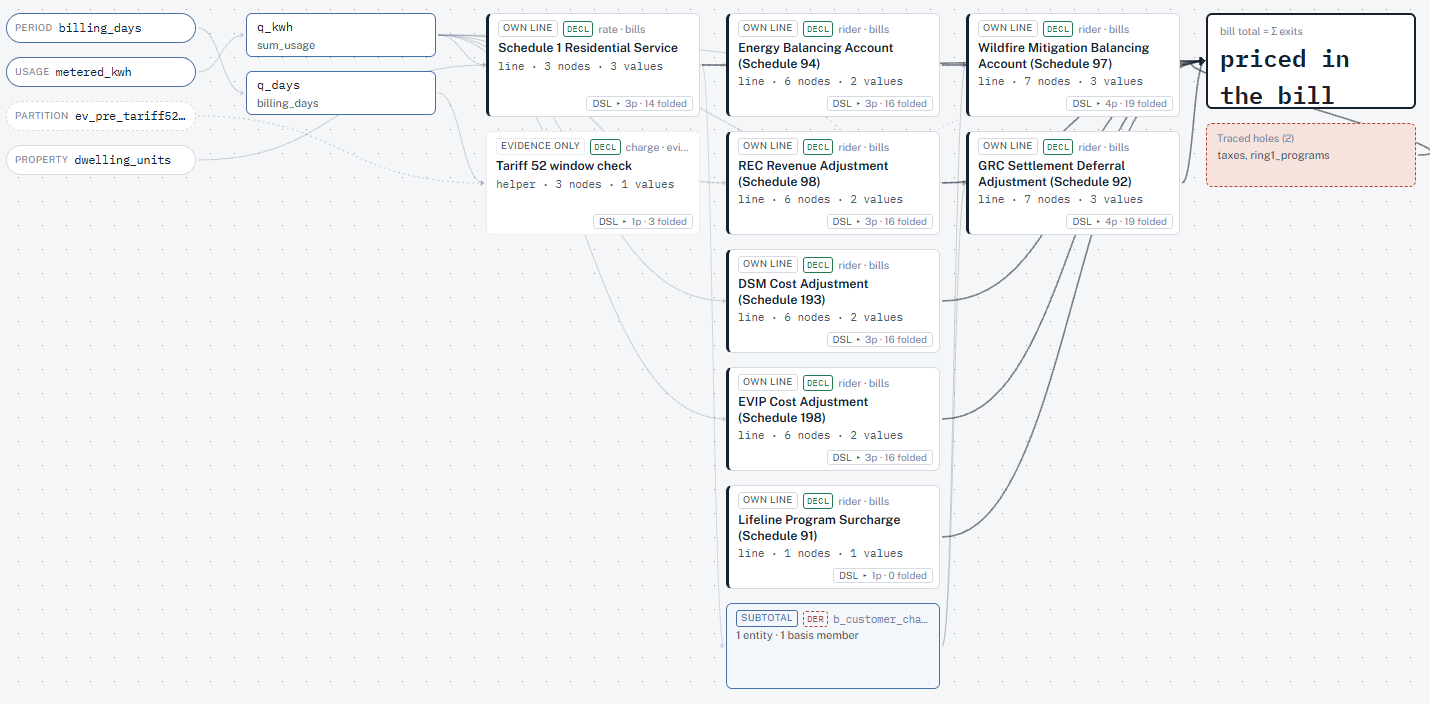
RateCosmo Studio: a residential schedule's entity graph, from inputs through the base schedule, riders and balancing-account adjustments to the bill total, with two traced gaps shown separately.
How we build · Studio, our workshop

Agent-led rate development

Agents source the tariff book, index it, build every schedule and rider as entities, and compile the engine. A separate agent reviews the work against the source.

  • Releases must follow the automated route; hand steps are refused
  • Builder and reviewer are different agents; disagreements become typed questions
  • Every entity opens to its source page; every gap is named

Studio is not a product for sale. What you receive is the evidence: every number, its page, and every named gap.
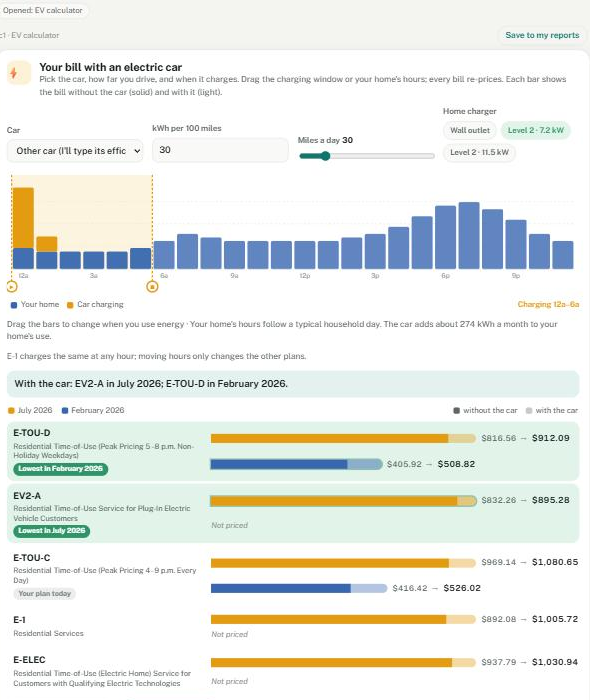
RateCosmo Advisor: an agent-composed EV charging calculator with a draggable hourly usage chart and a live comparison across plans, some marked Not priced.
Reference app · Advisor

Cost intelligence, composed live

Ask “does charging overnight help?” and the agent opens a working calculator on the real rating engine, reads the results, and explains them.

  • Drag the charging window; every plan re-prices
  • Every amount the agent says is a cited engine result
  • Plans it can't price say “Not priced”, not a guess

Embedding Advisor under a partner's brand is by arrangement; it is not a shipped feature today.

Developers · APIs & agents

Two APIs: one computes, one reasons. Bring your own agent.

The same engine behind Advisor, as infrastructure for your product or your agent. Compute runs today on the rate families we serve; the reasoning API, agent access over MCP and Verify are in preparation and are labelled so below.

Compute

Send a rate, a billing period and usage — interval or monthly. Get every bill line, itemized, with the tariff sheet it came from. An input the tariff needs but the call didn't send comes back as a typed refusal — not a number.

Reason In preparation

Advisor already answers a rate question in plain language from engine results and the entities that priced them. The same reasoning as an API you call is in preparation.

Your agent, over MCP In preparation

Priced lines, citations and typed refusals are already structured results. An MCP connection, so the agent you already run can call them, is in preparation.

Verify In preparation

Each priced line carries the sheet it came from. A call that checks a number your agent quoted against the engine result and that sheet is in preparation.

Priced for agents: start free, pay for scale and service. The developer preview and its free tier are in preparation; API access today is arranged per partner.

Enterprise preview · by arrangement

Run it in your own environment.

For enterprises whose data cannot leave. This is the design of the enterprise tier, arranged per deployment — none of it is deployed today.

The agent runs inside

Designed so the rate agent is deployed within your own environment, next to the systems it serves.

Your own model

Designed to reason with the large language model your enterprise already runs and governs.

Zero data retention

Designed so that we keep none of your usage, bills or questions.

Data stays home

Designed so customer and meter data never leave your boundary; only the rate models come in.

Trust by design

It cites. It checks. It knows what it doesn't know.

Three promises, each shown below as it appears in the product — and a grade that says how far a model has been proven.

1 · Referenced

A source behind everything — no invented numbers.

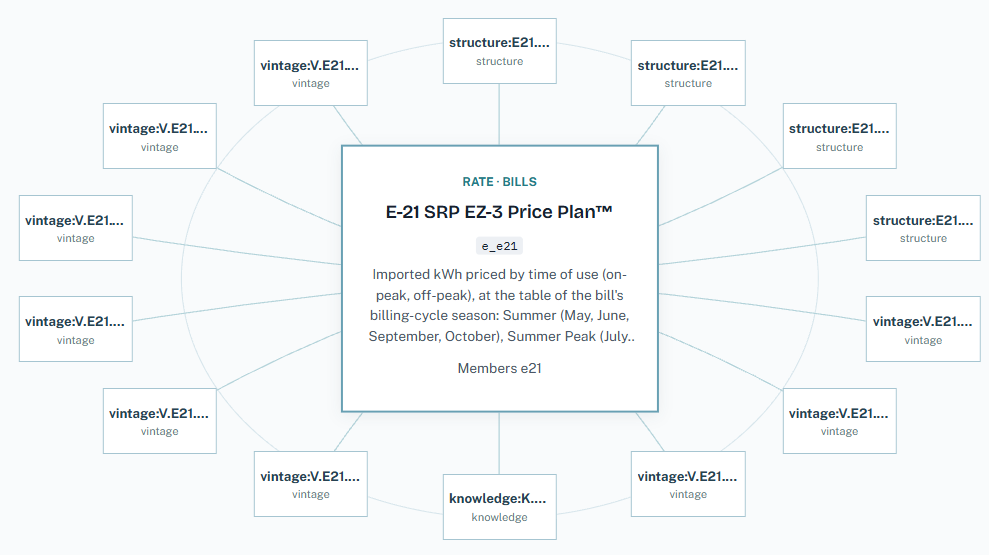
Every entity in a model points to the tariff rows it was built from, and every number to the page it came from. An answer with a number that can't be traced is rejected.

RateCosmo Studio, References view: the rate entity E-21 SRP EZ-3 Price Plan at the centre, linked to each structure, vintage and knowledge row of the tariff it was built from.
One rate entity and every tariff row it cites · Studio, live capture
2 · Validated

Seven gates, plus a reviewer that did not build it.

Each stage passes a gate before the next begins, and every round it took to pass is recorded — a model is checked against the page, replayed against real bills where they are available and reviewed by a reviewer that did not build it before it prices a single bill.

Graded

Analytical grade today. Billing grade is earned on real bills.

Analytical grade: every value matches the published tariff, and every gate has passed — fit for comparison, planning and proposals. Billing grade: the model has also been calibrated against real bills, line by line — the next level, not yet reached by any family. A family moves up only with bills its owner has authorised us to use — which is why a partner's bill data makes the model more valuable for everyone who prices on it.

3 · Honest

It knows what it doesn't know.

A real exchange from the product. The answer carries the sheets it relied on — and where the published tariff is silent, it names the gap instead of filling it with a guess.

You

Why is my CARE discount $329.09?

RateCosmo

The CARE tariff sets a 35.000% discount on your E-TOU-D charges.11 It excludes the California Climate Credit from the discount calculation.14

Typed gap, not a guessThe published rate information does not show a line-by-line CARE discount base for your bill, so it does not provide an exact breakdown of how −$329.09 was determined.
11. PG&E Schedule D-CARE · sheet 59087-E · p.2 14. PG&E Advice Letter 7191-E · sheet 54734-E · p.245
Who it's for

Rate infrastructure for modern energy applications.

Each use below works today on the utilities and rate families we serve; coverage grows family by family. We don't collect data, manage bills or sell solar software. We never compete with the companies building on us.

Panels of holographic operating dashboards split by a beam of light.
Energy data platforms

The rate layer for your data layer.

You hold the meter and bill data; we add the tariff that prices it — every line cited, every gap named.

A holographic energy dashboard above a solar panel.
Solar, storage & EV

A real baseline before the savings.

The customer's actual tariff inside the proposal flow, through one API.

A city skyline at sunrise reflected on a grid-lined plaza, data panels floating beside it.
Enterprise & AI load

What a new load really costs.

Price a site or a demand profile against the actual tariff, every charge explained.

Bill management & audit providers

The engine behind your audit.

Your team runs the audit; on the commercial schedules we serve, our engine re-prices a bill line by line and shows which charge, rider or demand ratchet moved it, each traced to its page.

Agent developers

A rating engine your agent can call.

Priced lines, citations and typed refusals instead of a model's guess at a tariff.

A glowing globe arcing over a city skyline and water, wind turbines on the horizon.
The vision · AI for energy

Today, rates. Tomorrow, the whole grid's arithmetic.

A model that understands a tariff can understand the rest of the money moving across the grid. Rates come first, because every other decision depends on them.

  • NowResidential rate families, with C&I rolling out; Advisor and the pricing API
  • NextC&I across every utility we serve, portfolio analytics
  • ThenAn enterprise's own AI connected directly; VPP dispatch, data-centre load, grid settlement